
When a Patient's Experience Challenges the System: Reflections on Medicinal Cannabis in Palliative Care
Written by Catherine Hanson
As a social worker and counsellor working in cancer care and palliative care, I have often found myself sitting at the intersection of competing realities. There is the reality of policy, organisational processes, clinical guidelines and professional boundaries. Then there is the reality of the person sitting in front of us, living with pain, fear, uncertainty and, sometimes, the knowledge that they are approaching the end of their life.
A recent experience highlighted this tension for me.
I was supporting a young adult with advanced illness who was nearing the end of life. Like many people in this situation, they were experiencing a range of distressing symptoms, including pain, anxiety and poor sleep. Through informal networks, they had obtained cannabis and reported that it was helping significantly. They described improvements in comfort, reduced anxiety and better sleep. Most importantly, they felt they had found something that was improving their quality of life at a time when quality of life mattered enormously.
As their condition deteriorated, I wondered whether a prescription for medicinal cannabis might provide a safer and more clinically supported pathway than relying on an informal supply. I raised the possibility with a member of the clinical team, expecting at least a discussion about whether this might be an option worth exploring.
The response was clear: medicinal cannabis was not something the service was considering.

Oreti beach
What struck me was not the response itself. Clinical teams make difficult decisions every day, and there may have been valid reasons behind that position. Rather, what stayed with me was how quickly the conversation seemed to close down. There appeared to be little space for curiosity about the patient’s experience, despite their reporting tangible benefits.
I do not see this as a debate about cannabis alone. Rather, it raises wider questions about innovation, patient autonomy and the ways healthcare systems respond to change. As interest grows in medicinal cannabis, psychedelic-assisted therapies and other novel approaches to alleviating suffering, these questions are likely to become increasingly relevant across palliative care settings.
The situation above left me reflecting on a broader question: what happens when patients’ lived experiences challenge established models of care?
Palliative care has long championed person-centred practice. We encourage patients to tell us what matters most to them. We seek to alleviate suffering in all its forms: physical, emotional, social and spiritual. Yet when it comes to emerging therapies or medicines that sit outside traditional practice, our systems can sometimes struggle to hold that same spirit of curiosity and openness.

Bluff
The barriers are understandable. There are regulatory considerations, limited evidence in some areas, organisational policies, funding constraints and concerns about safety. There are also cultural factors. Decades of stigma surrounding cannabis continue to shape attitudes, even as medicinal cannabis becomes increasingly accepted within healthcare settings internationally.
Healthcare professionals may also find themselves navigating uncertainty. Many have received little education regarding medicinal cannabis and may feel uncomfortable discussing it with patients. In such contexts, caution can become the default response.
Yet from a palliative care perspective, I wonder whether there is value in asking different questions.
What can we learn from patients who tell us that a particular intervention has improved their quality of life?
How do we balance evidence-based practice with compassionate responsiveness to individual experience?
How do we create space for conversations about emerging therapies without becoming polarised into positions of advocacy or opposition?
Most importantly, how do we ensure that people approaching the end of life feel heard when they describe what is helping them?
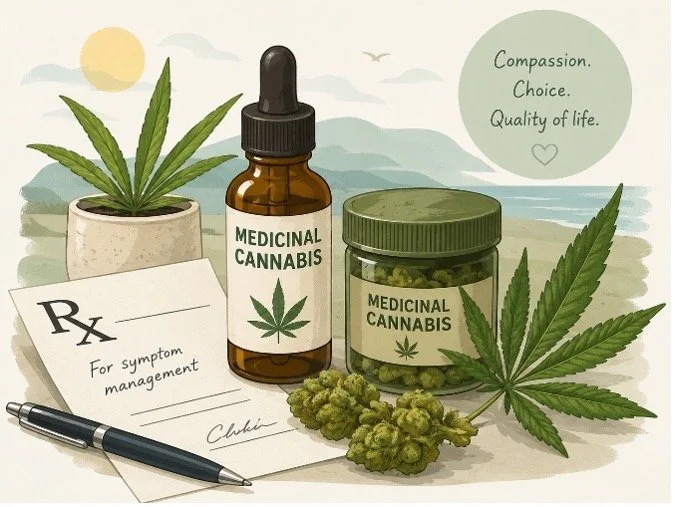
For me, the experience served as a reminder that progress often begins with conversation. Before new approaches can be integrated into practice, there must first be space for curiosity, reflection and respectful dialogue.
The patient at the centre of this story will never know the impact they had on my thinking. Sadly, they died not long afterwards. Yet their experience continues to prompt an important question: when someone living with a life-limiting illness tells us that something is helping, how do we ensure we are truly listening?
Bio:
Catherine Hanson is a Registered Social Worker, counsellor and trauma-informed therapist with more than 35 years of experience working across healthcare, Child Protection, Humanitarian settings, mental health, cancer care, and palliative care in New Zealand and internationally. She currently works within a Cancer Psychosocial Service, supporting people and whānau navigating the emotional, social, and existential challenges of cancer and serious illness.
Catherine holds a Master of Health Science with Distinction, with an endorsement in Palliative Care. Her Master’s research explored the emerging role of psychedelic-assisted therapies in palliative and end-of-life care, reflecting her interest in innovative, compassionate approaches to alleviating suffering and supporting meaning, dignity and quality of life at the end of life.